
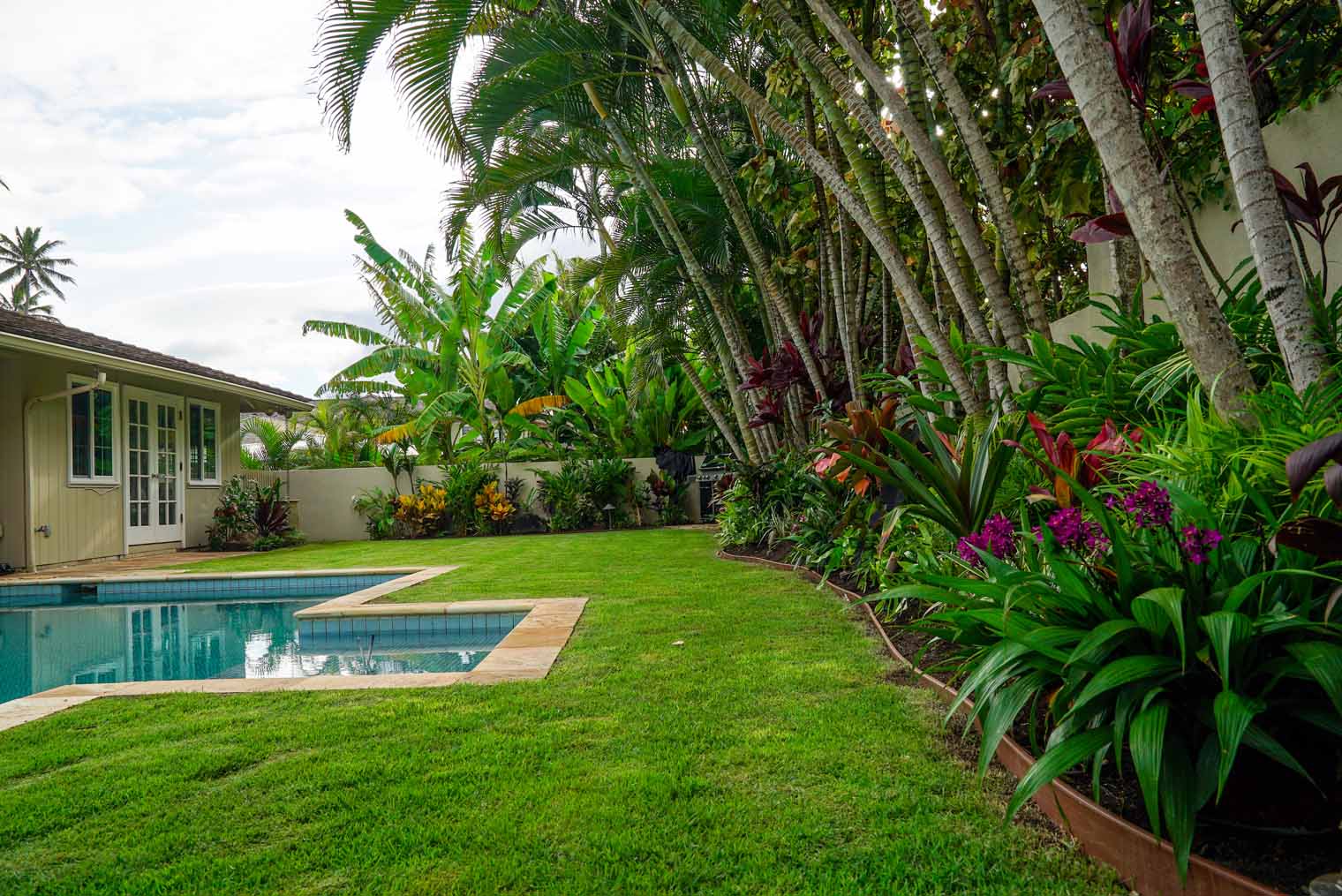
If you’ve ever tried to maintain a yard on the windward side of Oahu and wondered why the same plants that thrive in Kailua seem to struggle in Kane’ohe — or vice versa — you’re not imagining things. Landscaping in windward Oahu is genuinely different from anywhere else in Hawaii, and it’s definitely different from anything you’d read in a mainland gardening guide. The Ko’olau Range doesn’t just give our side of the island its name — it shapes everything about how we think about soil, drainage, plant selection, and long-term lawn health.
At Ko’olau Landscaping, we’ve spent years working across windward Oahu communities — from Kailua and Lanikai to Kane’ohe, He’eia, and Ka’a’awa. Here’s what we’ve learned, and what every windward homeowner should understand before their next landscaping project.
The Windward Climate: More Than Just Rain
Windward Oahu receives significantly more rainfall than the leeward side. Kane’ohe averages around 65 inches of rain per year, while some upper Ko’olau areas see well over 100 inches annually. Compare that to Honolulu’s 17 inches and you start to understand why the same landscaping playbook simply doesn’t apply.
But rainfall isn’t the only variable. The trade winds that push moisture up against the Ko’olau pali create a consistent pattern of cloud cover, humidity, and afternoon showers that affect:
- Soil saturation and drainage — clay-heavy windward soils hold water longer, which can suffocate root systems if not addressed
- Fungal pressure — persistent moisture creates conditions where fungal disease in turf and ornamentals spreads quickly
- Salt air exposure — coastal windward communities like Lanikai and Kailua Beach Park face salt-laden tradewind air that stresses certain plant species
- Light levels — overcast afternoons mean some sun-loving plants underperform compared to their potential on the leeward side
Understanding these variables isn’t just academic. It’s the difference between a landscape that thrives and one that requires constant, expensive intervention.
Soil Is the Foundation — And Windward Soil Is Complicated
Most windward Oahu properties sit on one of two soil types: Oxisols (highly weathered, iron-rich red soils common in upland areas) or Inceptisols (younger, less developed soils found closer to the coast and in valley bottoms). Both present drainage challenges.
Red clay soils, while nutrient-rich in some respects, compact easily and drain poorly. During heavy rain — which happens often here — these soils can become waterlogged within hours, leading to root rot in ornamentals, dead patches in turf, and erosion on slopes.
Before any planting project, a windward landscaper should be thinking about:
- Soil amendment: Incorporating compost, perlite, or coarse sand to improve drainage and aeration
- Raised planting beds: Elevating root zones above grade-level saturation zones
- French drains and swales: Directing subsurface water away from planted areas and structures
- Mulching strategy: A 2–3 inch layer of organic mulch regulates soil temperature, reduces compaction from heavy rain impact, and retains the right amount of moisture without oversaturation
Skipping this foundation work is the single most common reason windward landscaping projects fail within the first two years.
Native and Adaptive Plants That Actually Thrive Here
One of the most frequent questions we hear from windward homeowners: “What plants will actually survive in my yard?” The good news is that the windward climate — while demanding — supports a remarkably lush and diverse plant palette when you work with it rather than against it.
Hawaii Native Plants Worth Featuring
‘Ōhi’a lehua (Metrosideros polymorpha) is the iconic red-flowered tree of the Ko’olau uplands, and for good reason — it evolved here. While it grows slowly, mature ‘ōhi’a provide year-round color, support native birds like the ‘apapane, and require virtually no irrigation once established.
Hala (Pandanus tectorius) tolerates both coastal salt air and consistent moisture, making it an ideal structural plant for windward coastal properties. Its bold, architectural form adds visual interest while requiring minimal maintenance.
Naupaka kahakai (Scaevola taccada) is a native coastal shrub that excels as a low-maintenance hedge or erosion-control planting near the shoreline. Drought-tolerant once established and completely unfazed by salt spray.
Proven Ornamentals for the Windward Garden
Beyond natives, several introduced species have proven themselves in windward conditions:
- Heliconia varieties thrive in the warm, humid, partially shaded conditions common in Kane’ohe and He’eia valleys
- Bird of paradise (Strelitzia reginae) handles coastal exposure well in higher-light windward spots
- Ginger (both culinary and ornamental varieties) flourishes in the consistent moisture of windward valleys
- Plumeria performs beautifully in the sunnier windward microclimates — Kailua in particular — but struggles in areas with persistent cloud cover
What to Avoid
Lavender, rosemary, and most Mediterranean herbs are frustrating choices for windward yards — they evolved in dry, well-drained conditions and resent the persistent humidity. Similarly, succulents and cacti that do well in ‘Ewa or Kapolei will typically rot out within a season on the windward side.
Lawn Care on the Windward Side: A Different Rhythm
Windward lawn care operates on a different calendar than the rest of Oahu. The biggest mistake homeowners make is over-irrigating — the rain does most of the work, and supplemental irrigation in wet months pushes turf toward fungal issues like brown patch and dollar spot.
For windward turf, we generally recommend:
- Zoysia grass for most residential applications — it tolerates shade, handles periodic flooding better than Bermuda, and recovers well from heavy foot traffic
- Mowing at proper height: Keep zoysia at 1.5–2 inches. Scalping the lawn in humid conditions invites disease and weed pressure
- Fertilizing lightly and frequently rather than heavy applications that push excessive growth the wet climate makes hard to manage
- Fungicide programs for properties with recurring brown patch, particularly in shaded areas with poor air circulation
Aeration is critically important on windward properties — ideally twice per year — to combat the compaction that heavy rainfall and clay soils create over time.
Slope and Erosion: The Windward Homeowner’s Biggest Risk
Many windward properties have slopes — some gentle, some dramatic — and heavy tropical rain events test every one of them. Erosion on unprotected slopes can be rapid and expensive to remediate.
Effective slope management on windward Oahu typically combines:
- Deep-rooted groundcovers like mondo grass, liriope, or native ‘uhaloa that bind soil without requiring constant maintenance
- Boulder or stone retaining walls built to Hawaii’s specific soil and seismic conditions
- Strategic tree placement whose root systems anchor larger slope areas over time
- Erosion control fabric used during establishment periods before groundcovers fill in
This is an area where working with a landscaping company that knows windward-specific soil behavior genuinely matters. Mainland erosion control approaches often underestimate both the volume and velocity of water that Ko’olau rainfall produces.
Working With the Land, Not Against It
The homeowners who end up with the most beautiful, low-maintenance windward yards are the ones who embrace what the Ko’olau climate offers rather than fighting it. This means leaning into lush tropical plantings rather than trying to recreate a desert garden, designing drainage in from the beginning rather than adding it as a fix, and choosing plants whose natural habitat mirrors windward conditions.
Windward Oahu is one of the most botanically rich environments on earth. With the right approach, your yard can reflect that.
Ko’olau Landscaping serves homeowners and commercial properties across windward Oahu, including Kailua, Kane’ohe, He’eia, Ka’a’awa, Punalu’u, and surrounding communities. Contact us for a free on-site consultation and estimate.